BioLLM: DrugSensitivity Task
This document explains the implementation of the DrugTask class for drug annotation tasks. It covers the major steps involved in training and evaluating models using various available options like scGPT, scBERT, scFoundation, Geneformer, and others. The following sections describe the main features, functions, and usage of the DrugTask class in detail.
Table of Contents
Overview
Model Selection
How to Use
Functionality Details
Running the DrugTask
1. Overview
The DrugSensitivity is designed to facilitate drug annotation through data processing, model training, and evaluation. It supports multiple models including scGPT, scBERT, scFoundation, and Geneformer. The workflow includes:
Preprocessing input data
Performing model pretraining (if applicable)
Extracting features
Training the model
Testing and evaluation
2. Model Selection
The implementation allows you to use several models to perform drug annotation. Here is a list of models available:
scGPT: A generative pre-trained transformer specialized for single-cell data.
scBERT: A BERT-like model for single-cell annotation.
scFoundation: A foundational model for single-cell data analysis.
Geneformer: A transformer model tailored for gene-level tasks.
To select a specific model, change the value of model_select in the __main__ block of the code:
model_select = 'scgpt' # Options: 'scgpt', 'scbert', 'scfoundation', 'geneformer'
3. How to Use
To use the DrugSensitivity class, follow these steps:
Configure Model Selection: Choose the appropriate model by setting the
model_selectvariable.Run the Task: Execute the script to start the training and evaluation process.
4. Functionality Details
Key Functions
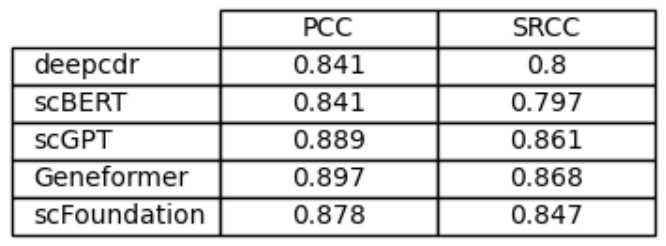
__init__: Initializes theDrugTaskwith the given configuration file, sets up necessary device information, and prepares initial settings.pretrain_inference(): Performs pretraining and generates embeddings for the gene expression features. Depending on the model, different preprocessing and embedding methods are applied.train(): Handles the training process for the selected model. Includes early stopping to prevent overfitting.test(): Evaluates the model on the validation dataset and calculates various metrics such as Pearson Correlation Coefficient (PCC) and Spearman rank correlation.run(): Main function that orchestrates data processing, model pretraining, training, and evaluation.
Pretraining and Training
The pretraining stage involves processing the gene expression features (
gexpr_feature) using the selected model. For some models likeGeneformer, additional preprocessing steps are applied.During training, the model is trained for several epochs, and metrics are recorded to select the best-performing model.
Early Stopping
The training function implements early stopping if there is no improvement in PCC for patience consecutive epochs. This helps prevent overfitting and reduces computational costs.
5. Running the DrugTask
The DrugTask class can be run directly from the command line or integrated into a larger system. Use the following command:
from biollm.tasks.drug_sensitivity import DrugSensitivity

config_file = './config/embeddings/drug/gf.toml'
obj = DrugSensitivity(config_file)
obj.run()
Replace ./config/embeddings/drug/gf.toml with the appropriate path to your configuration files.
Example Configurations
Configurations for each model are available in the biollm/config/drug/ directory. Adjust the configuration file to specify paths to the input and output data, model parameters, and other settings as required.
Notes
Ensure the appropriate configuration file is provided.
Customize paths to the configuration and data directories based on your environment.
Sample Data
Figure
